Word Formation is a core chapter in Verbal Reasoning that tests your ability to manipulate, analyze, rearrange, and extract letters from English words. It evaluates your vocabulary, observation speed, and understanding of letter frequency.
Fundamentals of Word Formation
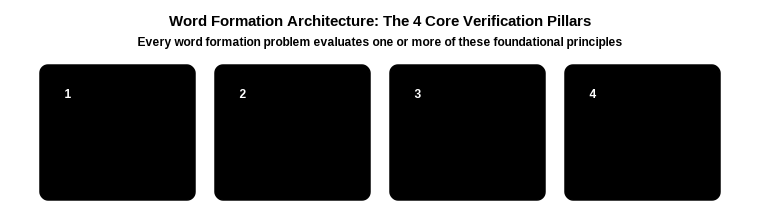
Before solving questions, every beginner must understand the four golden rules of this topic:
The Letter Frequency Rule (Repetition Limit):
You can only use a letter as many times as it appears in the parent word. If the parent word contains only one 'E', any option that uses two 'E's cannot be formed.
The New Letter Rule (Extraneous Letters):
You cannot introduce a letter that is not present in the original word. Even if a word makes complete grammatical sense, it is invalid if it contains an unlisted letter.
Position Counting (Left-to-Right Convention):
When a question refers to the 1st, 3rd, or 5th letter of a word, always count starting from the left end unless specifically told otherwise.
Standard Dictionary Words Only:
In questions that require forming "meaningful words," abbreviations (like 'TV' or 'USA'), acronyms, proper nouns (names of people or places), and slang are not accepted. The word must be an established English dictionary word.
Type 1: Finding the Word that CAN Be Formed
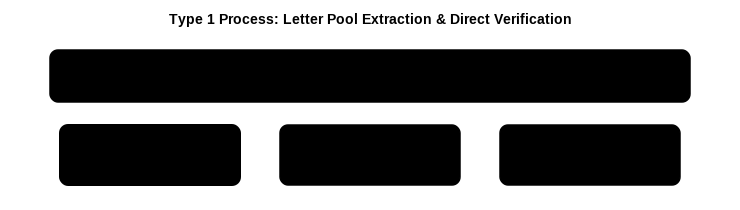
In this type, you are given a single root word followed by four options. Exactly one option can be formed using only the available letters (and their exact counts) from the root word. The other three options will contain either missing letters or extra repetitions.
Breakdown: Letters in SIGNIFICANT are S(1), I(3), G(1), N(2), F(1), C(1), A(1), T(1).
(A) FACT uses F, A, C, T. All four letters are present.
(B) NATION requires 'O', which is absent.
(C) TRAIN requires 'R', which is absent.
(D) FITTING requires two 'T's (SIGNIFICANT has only one 'T').
Answer: (A) FACT
Type 2: Finding the Word that CANNOT Be Formed
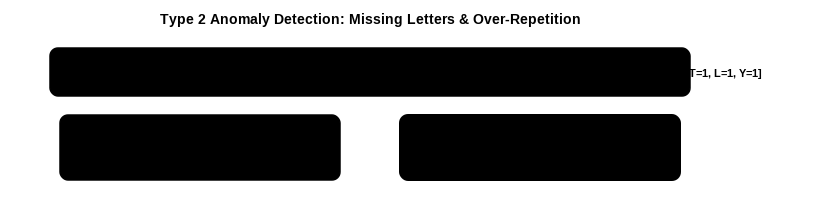
In this type, three of the given options can be formed using the letters of the parent word, while one option cannot be formed due to a missing letter or an excess repetition. You must identify that single impossible word.
Breakdown: Letters in CHOREOGRAPHY are C(1), H(2), O(2), R(2), E(1), G(1), A(1), P(1), Y(1).
(A) GRAPH uses G, R, A, P, H (All present).
(B) HERO uses H, E, R, O (All present).
(C) PORCH uses P, O, R, C, H (All present).
(D) PRACTICE requires 'T' and 'I', which are not present in CHOREOGRAPHY.
Answer: (D) PRACTICE
Type 3: Forming Meaningful Words from Specified Letter Positions
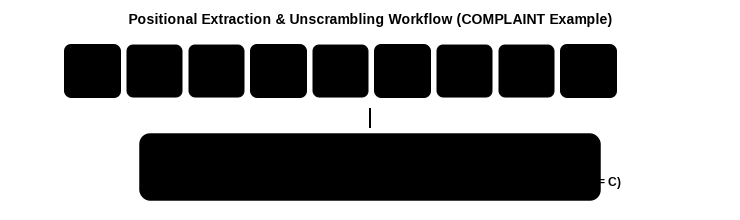
In this type, you are given a word and directed to pick specific letter numbers (such as 1st, 4th, 7th). You must unscramble those chosen letters to see if they can form a meaningful English word, using each extracted letter exactly once.
Standard question rules for this type:
• If only one word can be made, state a specific letter (such as the first or third letter).
• If more than one word can be made, mark X.
• If no word can be made, mark Z.
Example 1 • Word: COMPLAINT (1st, 4th, 6th, 9th)
Question: If it is possible to make only one meaningful English word from the 1st, 4th, 6th, and 9th letters of the word COMPLAINT, what will be the third letter of that word? If more than one such word can be formed, give 'X' as your answer. If no such word can be formed, give 'Z'.
Step 1: Extract the letters:
1st = C
4th = P
6th = A
9th = T
Step 2: Available letters are: C, P, A, T.
Step 3: Rearrange to find meaningful words: Word formed: PACT (an agreement). No other standard 4-letter English word can be formed using all four letters.
Step 4: Find the third letter of PACT: P (1st), A (2nd), C (3rd), T (4th).
Answer: C
Example 2 • Word: PLEASURE (1st, 2nd, 3rd, 4th)
Question: If it is possible to make only one meaningful English word with the 1st, 2nd, 3rd, and 4th letters of the word PLEASURE, which will be the second letter of that word? If more than one word can be formed, give 'X'. If no word can be formed, give 'Z'.
Step 1: Extract the letters:
1st = P
2nd = L
3rd = E
4th = A
Step 2: Available letters are: P, L, E, A.
Step 3: Rearrange to find meaningful words:
Word 1: LEAP
Word 2: PALE
Word 3: PLEA
Word 4: PEAL
Step 4: Since four distinct words can be formed, the condition for more than one word is met.
Answer: X
Example 3 • Word: DISCOVERY (1st, 4th, 6th, 7th)
Question: If a meaningful word can be formed using the 1st, 4th, 6th, and 7th letters of the word DISCOVERY, what will be the last letter? If more than one word can be formed, mark 'X'. If no word can be formed, mark 'Z'.
Step 1: Extract the letters:
1st = D
4th = C
6th = V
7th = E
Step 2: Available letters are: D, C, V, E.
Step 3: Try forming meaningful English words: DCVE, DCED, VECD, CDEV... none form a valid dictionary word.
Step 4: Zero words can be made.
Answer: Z
Example 4 • Word: POSTPONED (1st, 2nd, 3rd, 4th)
Question: If it is possible to make only one meaningful English word with the 1st, 2nd, 3rd, and 4th letters of the word POSTPONED, what is its first letter? If more than one word can be formed, mark 'X'. If no word can be formed, mark 'Z'.
Step 1: Extract the letters:
1st = P
2nd = O
3rd = S
4th = T
Step 2: Available letters are: P, O, S, T.
Step 3: Rearrange to find meaningful words:
Word 1: POST
Word 2: STOP
Word 3: SPOT
Word 4: TOPS
Step 4: More than one word can be formed.
Answer: X
Example 5 • Word: STANDARDS (1st, 3rd, 4th, 5th)
Question: If it is possible to make only one meaningful word using the 1st, 3rd, 4th, and 5th letters of the word STANDARDS, what is the last letter of that word? If more than one word can be formed, mark 'X'. If no word can be formed, mark 'Z'.
Step 1: Extract the letters:
1st = S
3rd = A
4th = N
5th = D
Step 2: Available letters are: S, A, N, D.
Step 3: Rearrange to find meaningful words: Word formed: SAND. No other valid common English word exists using all four letters.
Step 4: The last letter of SAND is D.
Answer: D
Type 4: Unscrambling Jumbled Letters into Meaningful Words
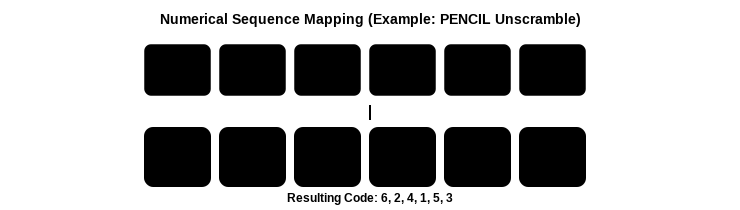
In this type, the letters of a word are scrambled, and each letter is assigned a number. You must determine the correct numerical sequence that spells out a valid English word.
Example 1 • Letters: C = 1, E = 2, L = 3, N = 4, I = 5, P = 6
Rearranging K, E, M, T, A, R reveals the word MARKET.
Mapping the letters of MARKET:
M = 3
A = 5
R = 6
K = 1
E = 2
T = 4
Sequence: 3, 5, 6, 1, 2, 4.
Answer: (A) 3, 5, 6, 1, 2, 4
Type 5: Word Formation by Adding a Single Letter (Prefix or Suffix)
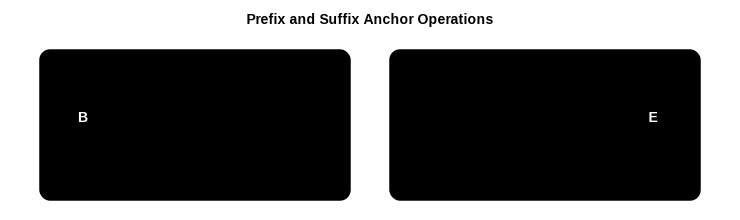
In this type, a set of 4 or 5 root words (or stems) is presented. You must identify which single common letter, when added either at the beginning (prefix) or at the end (suffix) of every word, turns all of them into new, meaningful English words.
Example 1 (Prefix) • Words: OWL, EAR, OLD, OIL, END
Question: Which single letter can be prefixed (added at the beginning) to all the following words to form five new meaningful words?
Options: (A) C, (B) B, (C) H, (D) T
Testing Option (B) 'B':
B + OWL = BOWL
B + EAR = BEAR
B + OLD = BOLD
B + OIL = BOIL
B + END = BEND
All five combinations form valid dictionary words.
Answer: (B) B
Example 2 (Suffix) • Words: CAR, RID, FIN, TAP, MAT
Question: Which single letter can be suffixed (added at the end) to all the following words to form five new meaningful words?
Options: (A) T, (B) E, (C) Y, (D) S
Testing Option (B) 'E':
CAR + E = CARE
RID + E = RIDE
FIN + E = FINE
TAP + E = TAPE
MAT + E = MATE
All five combinations form valid dictionary words.
Answer: (B) E
Example 3 (Prefix) • Words: LIP, POT, PIN, PAN, LOT
Question: Which single letter can be added to the start of all the following words to form five new meaningful words?
Options: (A) S, (B) C, (C) F, (D) T
Testing Option (A) 'S':
S + LIP = SLIP
S + POT = SPOT
S + PIN = SPIN
S + PAN = SPAN
S + LOT = SLOT
All five combinations form valid dictionary words.
Answer: (A) S
Example 4 (Prefix) • Words: OUT, AME, AKE, ART, ORE
Question: Which single letter can be prefixed to all the following words to form new meaningful words?
Options: (A) M, (B) R, (C) T, (D) P
Testing Option (C) 'T':
T + OUT = TOUT (to praise or solicit)
T + AME = TAME
T + AKE = TAKE
T + ART = TART
T + ORE = TORE
All five combinations form valid dictionary words.
Answer: (C) T
Example 5 (Suffix) • Words: BAR, MAR, PAR, DAR, SHAR
Question: Which single letter can be added to the end of all the following words to form five new meaningful words?
Options: (A) T, (B) E, (C) K, (D) D
Testing Option (C) 'K':
BAR + K = BARK
MAR + K = MARK
PAR + K = PARK
DAR + K = DARK
SHAR + K = SHARK
All five combinations form valid dictionary words.
Answer: (C) K
Strategy for Exam Accuracy
To maximize speed and prevent negative marking:
For "Cannot be Formed": Scan the options for rare or distinct letters (such as Z, X, Q, V, J, K) first. If an option has a letter that doesn't visually match the root word, verify it immediately instead of checking every letter one by one.
For "Can be Formed": Keep a tally of duplicate vowels (A, E, I, O, U). Exam setters frequently construct trap options that require two copies of a vowel when the parent word only contains one.
For "Letter Positions": Always write down the selected letters clearly on your rough sheet in a circle or box, count the total letters extracted, and test small, common prefixes/suffixes (like -ED, -ER, -ST) to spot words quickly.
Ready to Test Your Word Formation Speed?
Sharpen your vocabulary verification, letter tracking, and unscrambling speed with real competitive exam practice drills.