Data Sufficiency (DS) is a test of mathematical logic and decision-making rather than calculation endurance. Instead of calculating a final numerical value, your goal is to determine: "Is the provided information sufficient to reach a single, unique, definitive answer?"
Featured extensively in SBI PO Mains, IBPS PO, CAT, GMAT, and RBI Grade B
Evaluates sufficiency, not arithmetic output—never calculate until the last digit
Always evaluate Statement I alone and Statement II alone before attempting combination
Distinguish between "Value" questions (need 1 unique answer) and "Yes/No" questions (a definitive NO is sufficient)
1. The Standard 5-Option Elimination Grid
In almost all competitive exams, Data Sufficiency answer options follow a strict logical hierarchy. Memorizing this standardized code saves up to 30 seconds per question:
Option A (1 Alone)
Statement I alone is sufficient to answer the question, but Statement II alone is NOT sufficient.
Status: I = YES, II = NO
Option B (2 Alone)
Statement II alone is sufficient to answer the question, but Statement I alone is NOT sufficient.
Status: I = NO, II = YES
Option C (Either Alone)
Either Statement I alone OR Statement II alone is sufficient independently to solve the problem.
Status: I = YES, II = YES
Option D (Neither / Insufficient)
Statements I and II together are still NOT sufficient to answer the question. Additional data is required.
Status: Combined = NO
Option E (Both Together Necessary)
Both statements together are required to answer the question, but neither statement alone is sufficient.
Status: Combined = YES
Critical Elimination Rule: Never combine Statement I and Statement II unless both have failed independently! Combining them early leads to choosing Option E when the correct answer was Option A or B.
2. The Two Primary Question Types
Every problem stem falls into one of two categories. Applying the wrong sufficiency test guarantees an incorrect choice:
Type 1: "Value" Questions
Questions like "What is the age of Rohan?" or "What is the speed of the train?" require a single mathematical value.
If a statement yields x = 25, it is Sufficient.
If a quadratic statement yields x = 5 or x = -2, and age cannot be negative, x = 5 is unique → Sufficient.
If a statement yields x = 20 or x = 30 (both realistic possibilities), it is Not Sufficient.
Type 2: "Yes / No" (Boolean) Questions
Questions like "Is integer n odd?" or "Is Company A more profitable than Company B?" require certainty in either direction.
✗ Ambiguity: If n can be either odd or even depending on values → NOT Sufficient
✓ Definitive NO: If n is guaranteed even, the answer to "Is n odd?" is a solid NO → SUFFICIENT
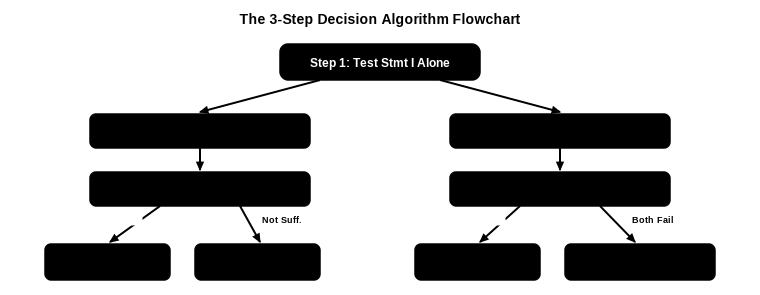
3. The 3-Step Systematic Solving Algorithm
Follow this strict evaluation sequence to avoid cross-statement contamination:
Step 1: Test Statement I Alone
Cover Statement II completely. If Statement I yields a unique answer, the choice is either A or C. If not, eliminate A and C immediately.
Step 2: Test Statement II Alone
Reset your mind. Do not import values or assumptions from Statement I. If Statement II is sufficient, the choice is either B or C.
Step 3: Combine (Only If Both Failed)
Combine both statements simultaneously. If the combined system yields a single unique answer, select E; otherwise, select D.
4. Step-by-Step Solved Demonstrations
Walk through these three solved demonstrations to see the algorithm in action:
Demonstration 1: A "Value" Question
Question: What is the monthly salary of Amit?
Statement I: Amit's monthly salary is 20% more than Sumit's monthly salary. Statement II: Sumit's monthly salary is Rs 40,000.
Test I Alone Amit = 1.20 * Sumit. Since Sumit's salary is unknown, Amit's salary cannot be determined uniquely. Statement I is NOT sufficient. (Eliminate Options A and C).
Test II Alone Sumit = Rs 40,000. Provides no information about Amit. Statement II is NOT sufficient. (Eliminate Option B).
Combine I + II From II, Sumit = Rs 40,000. Substituting into I: Amit = 1.20 * 40,000 = Rs 48,000. A single unique answer is obtained.
Correct Option: E (Both statements together are necessary and sufficient)
Demonstration 2: The "Definitive NO" Trap
Question: Is integer k divisible by 6?
Statement I: k is a multiple of 4. Statement II: k is a prime number greater than 5.
Test I Alone k can be 4, 8, 12, 16, 24... If k = 4, divisible by 6? No. If k = 12, divisible by 6? Yes. Gives both Yes and No → Statement I is NOT sufficient.
Test II Alone k is a prime number greater than 5 (7, 11, 13, 17, 19, 23...). A prime number greater than 5 has only factors 1 and itself, so it can never be divisible by 6. It yields a consistent, definitive NO.
Correct Option: B (Statement II alone is sufficient, while Statement I alone is not)
Demonstration 3: The Linear Equations Shortcut
Question: What is the combined cost of 1 pen and 1 notebook?
Statement I: The cost of 3 pens and 3 notebooks is Rs 90. Statement II: The cost of 2 pens and 5 notebooks is Rs 110.
Test I Alone 3 * Pen + 3 * Notebook = 90. Dividing by 3 yields: 1 * Pen + 1 * Notebook = 30. The question asks for the combined sum (1 Pen + 1 Notebook), not individual prices! Statement I is sufficient.
Test II Alone 2 * Pen + 5 * Notebook = 110. Cannot isolate (1 Pen + 1 Notebook) without introducing a second equation. Statement II is NOT sufficient.
Correct Option: A (Statement I alone is sufficient)
5. Top 5 Deadly Traps in Data Sufficiency
Trap 1: The "Calculation Obsession" Trap
Do not calculate down to the final decimal point. The moment you verify that an equation has one unknown with a unique solvable value, stop and mark it sufficient.
✗ Spending 90 seconds completing long division or factoring polynomials
✓ Stopping the instant unique solvability is confirmed
Trap 2: Information Leakage (Contamination)
When testing Statement II, students frequently carry over numbers or deductions made from Statement I. Treat Statement II as the only information provided on earth.
Trap 3: The "Two Equations = Always Solvable" Fallacy
Two equations with two variables are not always solvable. If they are collinear or dependent (such as 2x + 3y = 12 and 4x + 6y = 24), they represent the same line and yield infinite solutions → Insufficient.
Trap 4: The Unstated Integer Assumption
Unless the question stem explicitly says "positive integer", never assume variables cannot be negative, fractions, or zero.
Trap 5: The "Definitive NO Means Insufficient" Myth
In Yes/No questions, proving that an outcome is impossible answers the question with 100% certainty. A consistent "NO" is fully sufficient.
Ready to Test Your Data Sufficiency Skills?
Practice curated problem sets with timers, elimination palettes, and complete step-by-step explanations.