1. Fundamentals of Data Sufficiency
What Is Data Sufficiency?
In a standard reasoning question, you are given a set of facts and asked to find a specific answer (for example, finding a person's age, direction, rank, or code).
In a Data Sufficiency question, the structure changes:
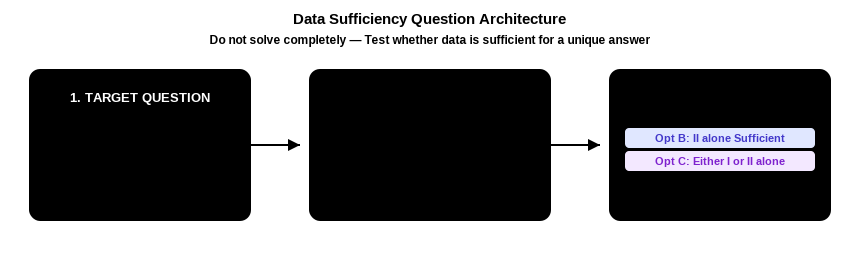
- You are given a Question.
- You are given two statements (labeled Statement I and Statement II) containing clues.
- Your objective is not to find the final numerical or logical answer, but to decide which statement (or combination of statements) provides enough information to arrive at a single, unambiguous answer.
The Standard Five Answer Options
Every Data Sufficiency question with two statements uses the following five standard options:
- Option A: Statement I alone is sufficient to answer the question, but Statement II alone is not sufficient.
- Option B: Statement II alone is sufficient to answer the question, but Statement I alone is not sufficient.
- Option C: Either Statement I alone OR Statement II alone is sufficient to answer the question.
- Option D: Neither Statement I nor Statement II is sufficient (even after combining both statements, the question cannot be answered).
- Option E: Both Statements I and II together are necessary to answer the question (neither statement alone is sufficient).
The Step-by-Step Solving Strategy
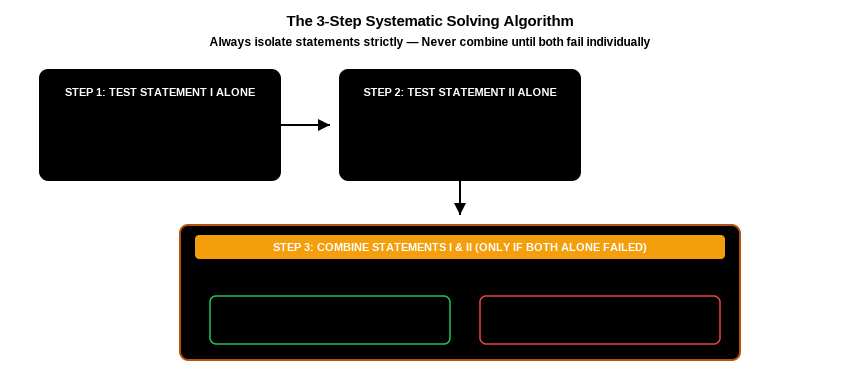
To eliminate confusion and avoid bias, evaluate the statements using a strict sequence:
-
Step 1: Test Statement I alone.
- Completely ignore Statement II. Treat Statement I as the only data in existence.
- If Statement I gives a single, definite answer: Statement I is Sufficient. Options B, D, and E are eliminated. (Only A or C remains).
- If Statement I does not give a single, definite answer: Statement I is Not Sufficient. Options A and C are eliminated. (Only B, D, or E remains).
-
Step 2: Test Statement II alone.
- Clear your mind and completely forget Statement I. Treat Statement II on its own.
- If Statement II gives a single, definite answer: Statement II is Sufficient.
- If Statement II does not give a single, definite answer: Statement II is Not Sufficient.
-
Step 3: Combine both statements (ONLY IF NEEDED).
- You combine Statements I and II only when both Statement I alone and Statement II alone have failed.
- If the combined data gives a single, unique answer: Choose Option E.
- If the combined data still leaves ambiguity or multiple answers: Choose Option D.

Golden Rules Every Beginner Must Remember
-
The "Unique Answer" Rule:
A statement is sufficient only if it gives one unique answer. If a statement narrows the answer down to two possibilities (for example, "Rahul is either 24 or 26 years old"), it is NOT sufficient. -
The "Definite Yes / Definite No" Rule:
If the question asks a Yes/No question (e.g., "Is P the brother of Q?"):- If a statement confirms definitely: "Yes, P is the brother" → It is Sufficient.
- If a statement confirms definitely: "No, P is not the brother" → It is also Sufficient.
- If a statement results in: "P might or might not be the brother" → It is Not Sufficient.
-
Never Assume Real-World Conventions:
Do not assume a person's gender from their name (e.g., names like "Kiran", "Suman", or "Bobby" can be male or female unless explicitly stated). Assume only universal geographical and mathematical facts (e.g., directions, basic arithmetic, standard calendar days). -
Never Carry Over Data Between Statements:
When testing Statement II alone, never use any clue from Statement I. This is the most common beginner error. -
Stop Solving Once Sufficiency Is Clear:
Once you know that a unique answer can be found, stop calculation immediately. Working out the full puzzle wastes valuable time.